Skip to content
Borge Labs

AI systems lab & product studio

Applied AI products, built for real constraints.

Borge Labs builds and operates applied AI products across cloud and self-managed environments, with privacy, evaluation, and guarded delivery designed in.

Founded and run by Eldar Borge. The work includes Politikkradar, Ordrett, independent platform tooling, and open-source agent and MCP projects.

politikkradar.no
Politikkradar: source-grounded AI for Norwegian public information.
Politikkradar is source-grounded AI for Norwegian public information.

Lead project

Politikkradar

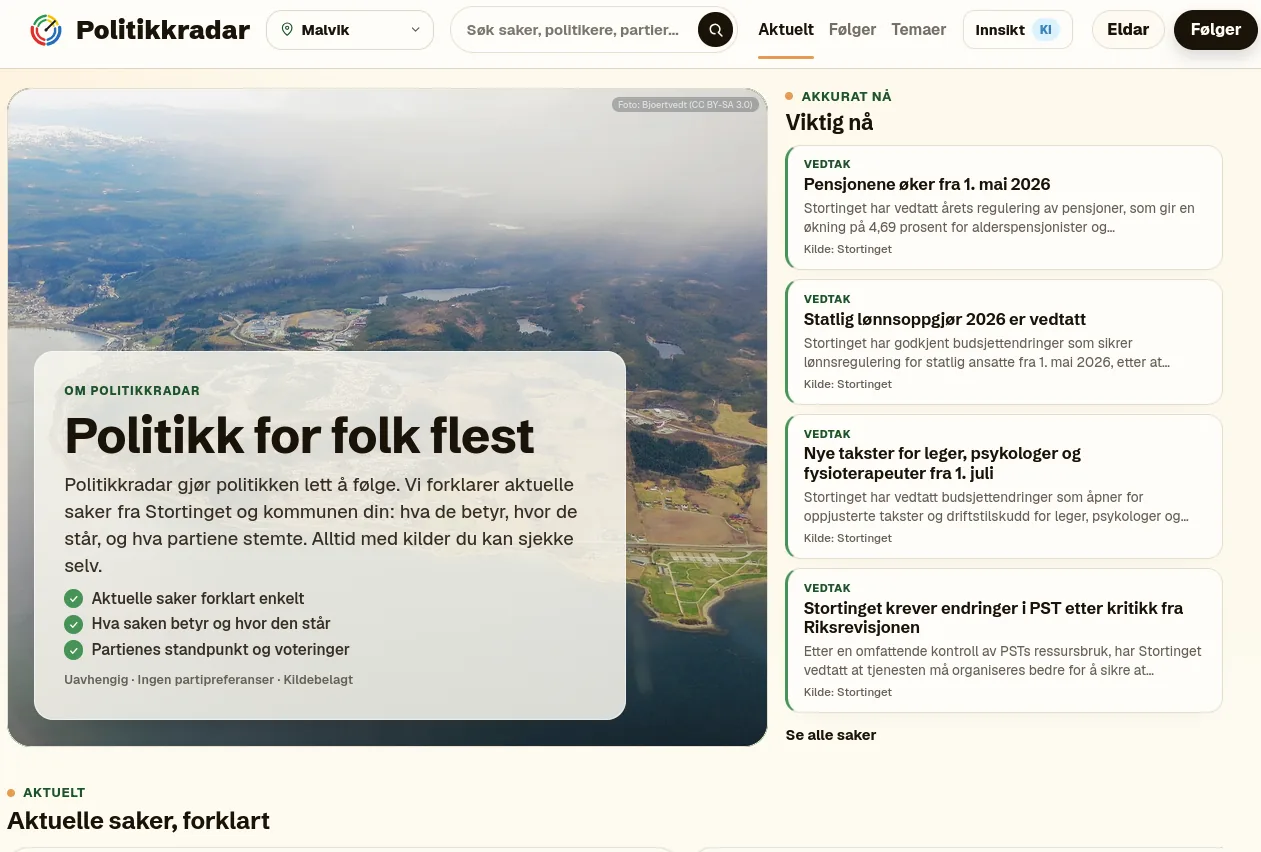
Politikkradar helps people follow Norwegian politics through simpler explanations, visible sources, and careful use of AI. National parliamentary coverage is live; the municipal rollout is intentionally limited to Malvik.

The service combines approved public sources, privacy filtering, stored AI-assisted enrichment, retrieval, and public provenance. Pages render from stored artifacts rather than making live model calls, so sources remain visible and missing work stays explicit.

  • Approved public sources
  • Privacy-filtered data
  • Stored AI-assisted enrichment
  • Source-grounded retrieval
  • EU-bound model processing
  • Public provenance

Live at politikkradar.no

iPhone + Android

Ordrett

Norwegian-first transcription for meetings, interviews, and lectures, with speaker labels, timestamps, summaries, and explicit uncertainty. Audio and temporary service copies are removed according to the documented lifecycle; delivered text is stored locally on the device.

Products and research releases

Live products sit alongside private dogfood systems and public research releases from the tools used to build them.

  • Private dogfood

    Kontert

    Self-hosted bookkeeping for sensitive financial data. Local AI proposes document extraction and double-entry classification, while invariants, append-only audit, and explicit approval protect the books.

  • Research release

    AI Team

    A Slack-native framework for scoped context, durable decisions, specialist AI roles, tool boundaries, and supervised handoffs into engineering work.

    View on GitHub
  • Research release + benchmarks

    AI Dev Team

    A supervised coding-agent runtime using separate Git worktrees, runner-observed verification, cost and review artifacts, approval boundaries, and documented benchmark tooling.

    Code and results
  • Open-source package

    Claude Second Opinion MCP

    A bounded, non-blocking MCP server for independent cross-model review, with strict output validation, explicit permission modes, best-effort packet secret checks, and honest insufficient-context results.

    View on GitHub

Selected work

The systems behind the products.

A few examples of how Borge Labs approaches infrastructure, delivery, and evaluation in systems it owns and operates.

  • Cloud and self-managed AI systems
  • Kubernetes, Helm, and GitOps
  • Documented evaluation infrastructure
  • MCP and supervised agent systems
  • Security, privacy, and least privilege
  • Observability, recovery, and cost control

Independent platform

Operating Borge Labs' own services

A self-managed Kubernetes and GitOps platform supports live services and GPU-backed processing across Borge Labs' own environment and cloud products.

The public lesson is the operating model: declarative changes, bounded access, monitoring, backup controls, recovery runbooks, and human review.

Research release + evaluation

Supervised coding agents

AI Dev Team runs coding agents in separate Git worktrees and records patches, tests, cost, review artifacts, and approval state.

The public record documents both positive and negative historical observations, including a fresh mixed-40 slice where a simpler single-model arm edged the portfolio. Raw run artifacts are not in the public snapshot, so the figures are context rather than independently reproducible capability claims.

Read the benchmark record

Operating model

Supervised multi-agent delivery

A delivery loop where frontier models plan and review, cheaper and local models implement, and every irreversible step passes an explicit human gate.

Agents work with read-only infrastructure credentials and write only through git. Independent review by a different model family is part of the loop, because a second family catches failure modes the first cannot see.

Read the design note

Engineering notes

Notes from the lab.

Longer-form notes on design decisions, evaluation practice, and the boundaries that keep supervised AI systems safe to operate. The notes are written in English.

A supervised multi-agent delivery loop

The operating model behind Borge Labs: issue-driven state machines, frontier models for planning and review, cheaper and local models for implementation, and a hard credential boundary.

Read the note

The feature we refused to build

Face recognition would have been the easy way to attribute speech in council videos. Why GDPR Article 9 ruled it out, and how the compliant pipeline works instead.

Read the note

Evaluations that changed decisions

Three times an evaluation overturned a plan: a broken retrieval route, a reviewer model blind to a whole bug class, and a benchmark where the simpler system won.

Read the note

Delivery Loop

Move quickly without losing the controls, and feed the learning back in.

The Delivery Loop is the working model behind Borge Labs: clarify the need, gather context, plan, implement in a controlled workspace, run independent checks, review the result, and feed the learning back into the system. The same loop applies to product work, infrastructure, and AI-assisted engineering.

Need → Context → Plan → Implementation → Tests → Review → Human decision → Learning

  1. Clarify & plan

    Pin down the need, gather context and approved sources, and write a plan at the right level of detail.

  2. Build under control

    Implement in a separate Git worktree with tests and review artifacts. Irreversible actions stay behind explicit human approval.

  3. Review & decide

    A human reviews and makes the call; the result and the learning feed back into the product and the next run.

Why we build it this way

The point is a more traceable path from idea to an improved product.

  • 01

    From idea to tested change, without losing context.

  • 02

    Use evaluation to reject complexity that does not earn its place.

  • 03

    Let products improve the tools, and the tools improve the products.

About

One engineer, clear ownership.

Borge Labs is built and operated by Eldar Borge, a tech lead and principal platform engineer. AI roles can help research, propose, implement, and review, but architecture, risk, quality, and production decisions stay human-owned.

Eldar Borge

Tech lead and principal platform engineer

More than a decade in customer-facing cloud and platform engineering. Independent work now focuses on applied AI systems, Kubernetes, GitOps, and evaluation.

How ownership works

  • Direct ownership of architecture, delivery, and operations.
  • Credentials and irreversible actions stay bounded even when AI roles do useful work.
  • Evaluation results and incidents feed back into the platform, runbooks, and next design.

AI Team documents the named workflow roles. They are a way to structure the work, not a headcount.

Let's build something useful.

Interested in Politikkradar, Ordrett, or the systems behind them?